Third Party Exit Interviews That Find Out Why They Really Left
Departing employees rarely tell their manager the real story. They will tell a neutral third party. empathiHR conducts confidential exit interviews by private video, reviews every answer, and tells you what you need to know.
Most exit interviews tell you nothing
Most employers skip the exit interview, or run it in a way that gets nothing useful. The employee sits across from the manager they are leaving, says better opportunity, and walks out. Phone interviews from an outside firm often feel adversarial, so people stay guarded there too. Answering on video, on their own time, removes that tension.
Four steps, and three of them are ours
You send a name. We do the rest and come back with a summary you can act on.
-
Illustrative sample data 1You send us a name
Tell us who is leaving, how to reach them, and their last day. That is the whole ask on your side.
-
Illustrative sample data 2We reach out
The employee gets a private link from empathiHR, in English or Spanish. It comes from us, not from you, which is the point.
-
Illustrative sample data 3They record their answers
A few minutes on video from a phone or computer, on their own time. No meeting to schedule and nobody on the other end pushing back.
-
Illustrative sample data 4You get answers
A plain written summary of what was said and what needs attention, usually within 5 business days.
Red flags do not wait
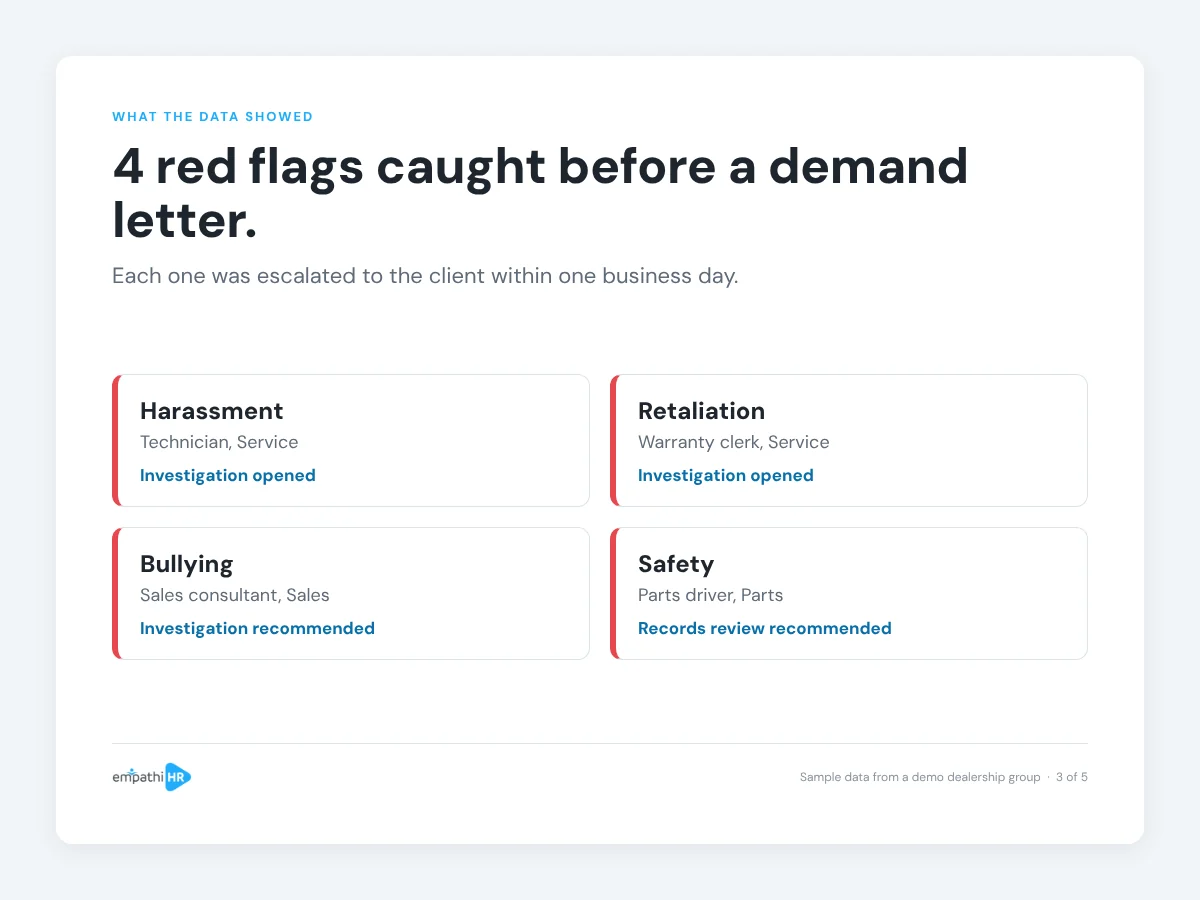
If a departing employee raises harassment, discrimination, retaliation, safety, bullying, or any other form of workplace misconduct, we call you within one business day and can open a workplace investigation right away. The exit interview becomes the intake, so nothing has to be collected twice. Investigations are already covered inside an empathiHR program, so one that starts here costs a program client nothing extra.
Every separation, documented the same way
- An exit interview for every separation, voluntary or involuntary
- A written summary for each exit
- A call within one business day on any red flag
- Dashboard access for two users, with every video, transcript, and summary
- Documentation when an employee declines or does not respond
- Quarterly trend reports by location, department, and supervisor
Exit interviews are the last link in the chain. The employee reporting hotline and the Quarterly Check-In tell you what is happening with the people still on your payroll. The exit interview closes the loop on the people walking out the door, which is usually when the most honest answers come out. We run exit interviews for employers nationwide, from single location shops to multi state operators.
What changes when someone else asks
The short version: you find out why people really leave, you catch legal problems before they grow, and you have the paperwork to show you listened.
Honest answers
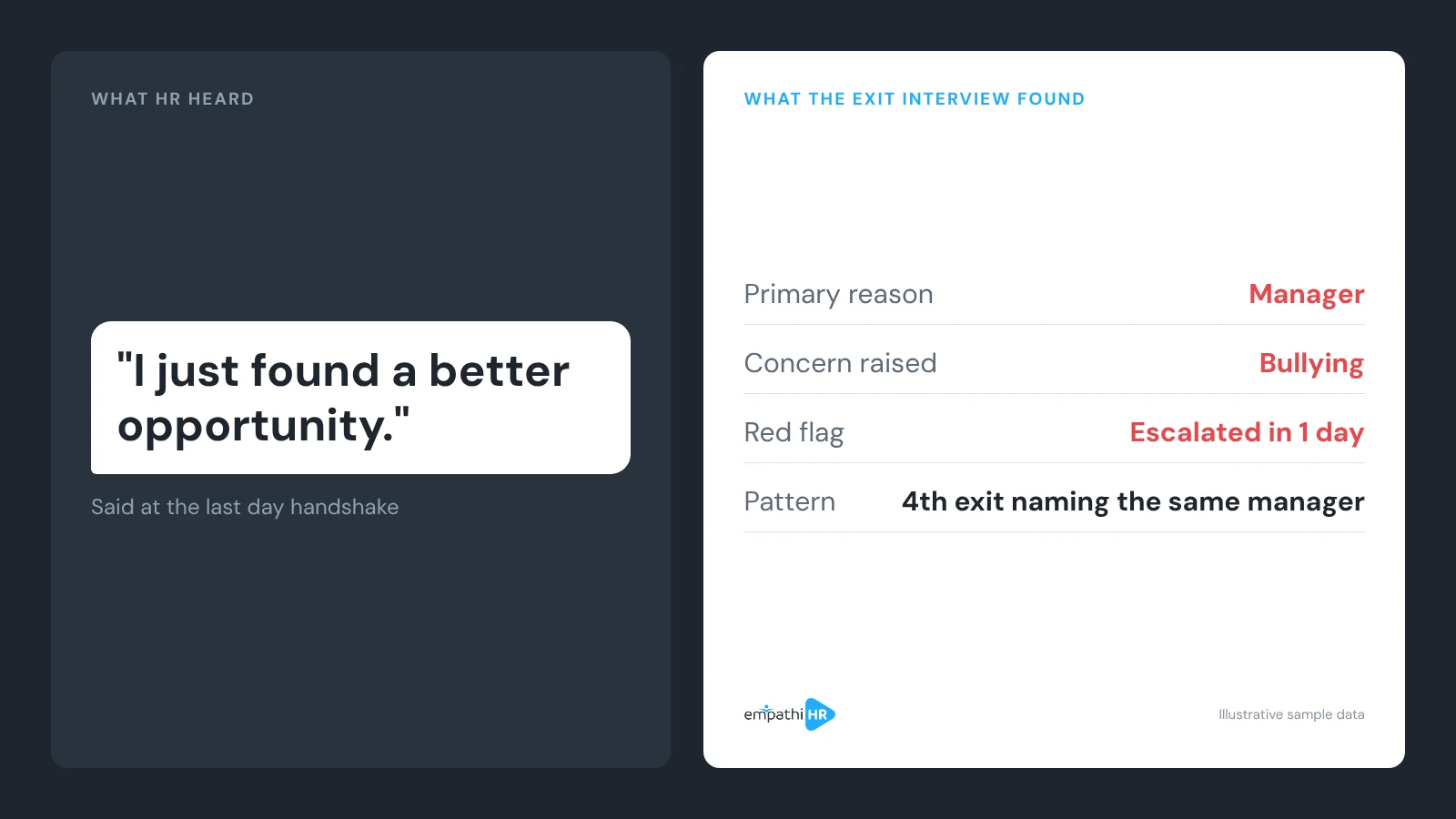
People say more to a neutral outside party than they will to the manager they are walking away from, especially when the manager is the reason.
Catch risk early
Harassment, retaliation, and workplace bullying surface while you can still look into them, instead of arriving months later in a demand letter.
A record you can stand on
Every exit is captured on video with a transcript and a written summary, including the ones where the employee declined to talk.
Spot the patterns
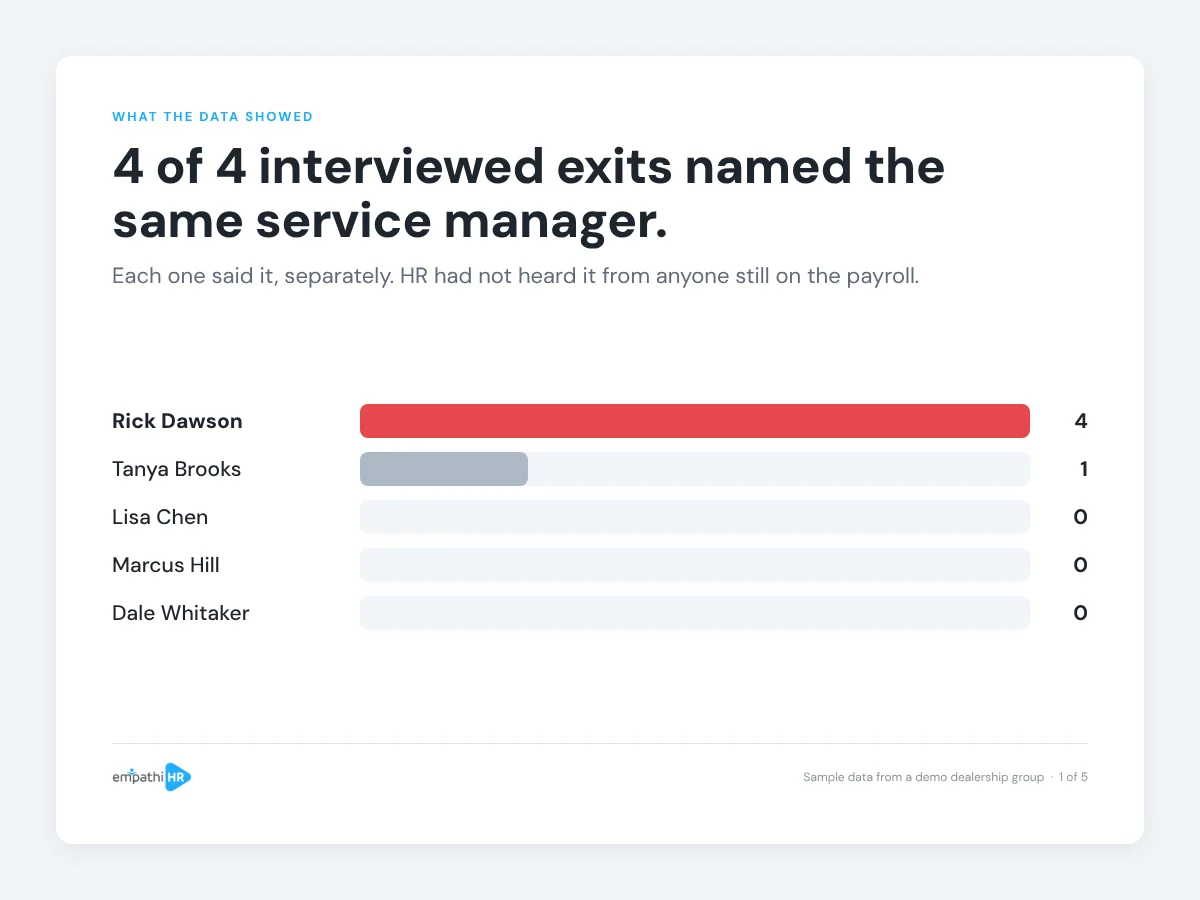
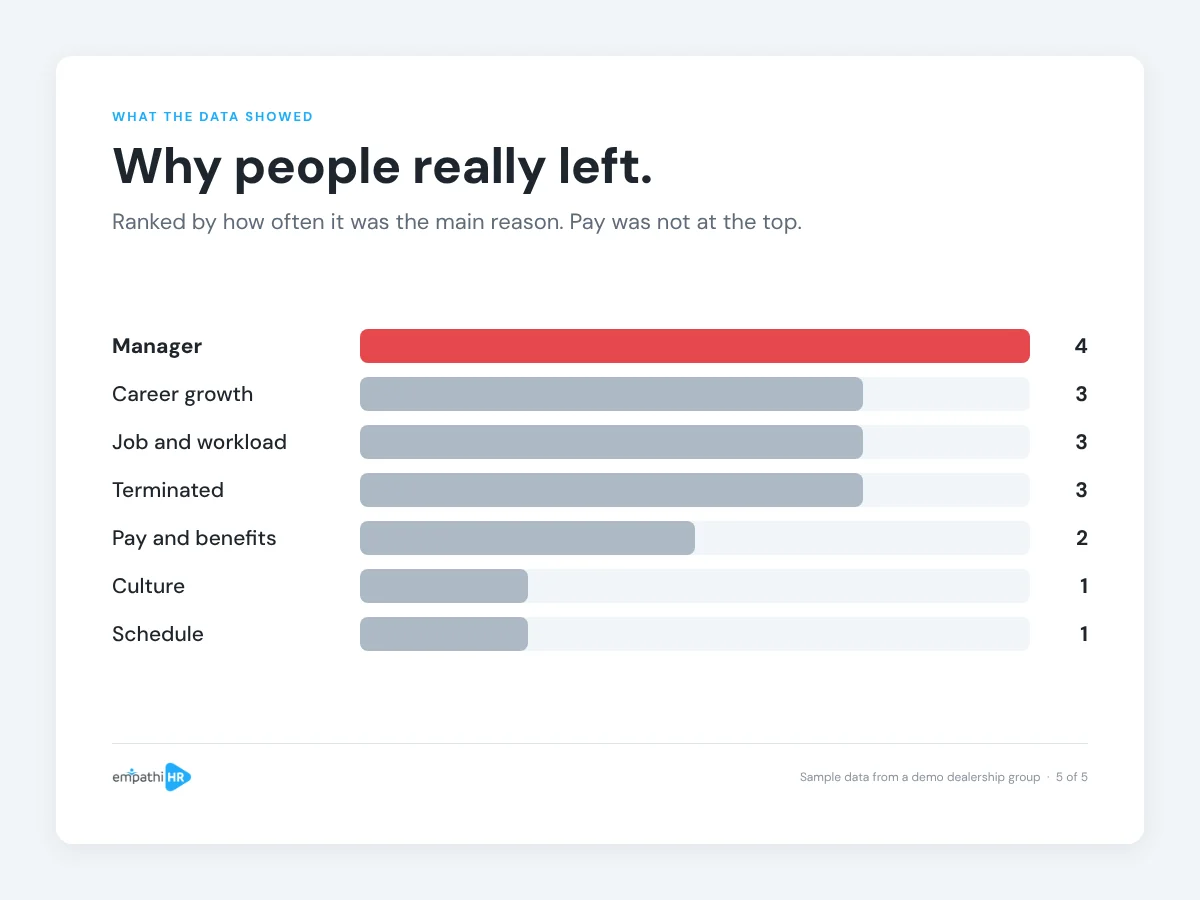
Quarterly trend reports break the answers out by location, department, and supervisor. If three people in six months leave over the same manager, you will see it.
Keep good people
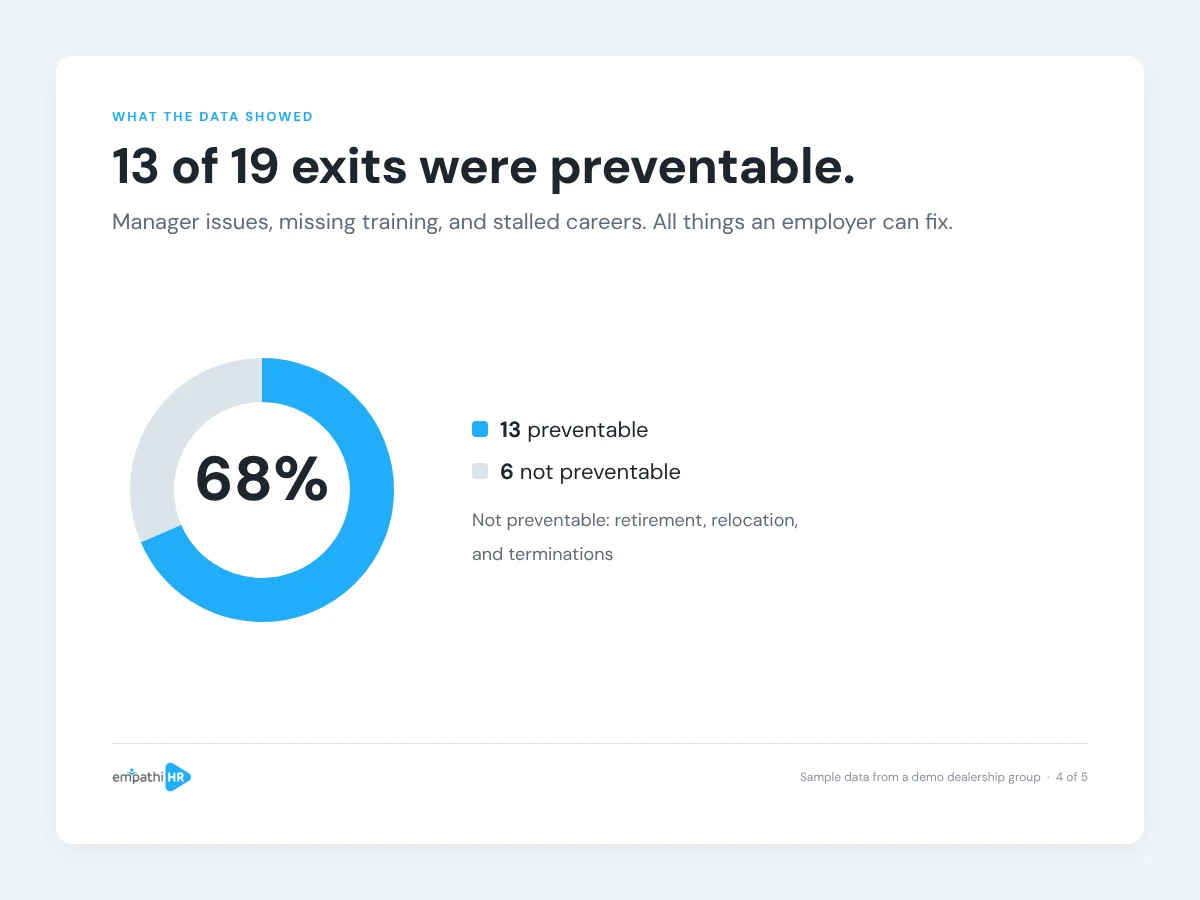
Most of what sends people out the door is management and workload, not pay. Those are things you can actually fix once you know about them.
No work for your team
We handle the outreach, the reminder, the review, and the write up. You send a name and get back a summary.
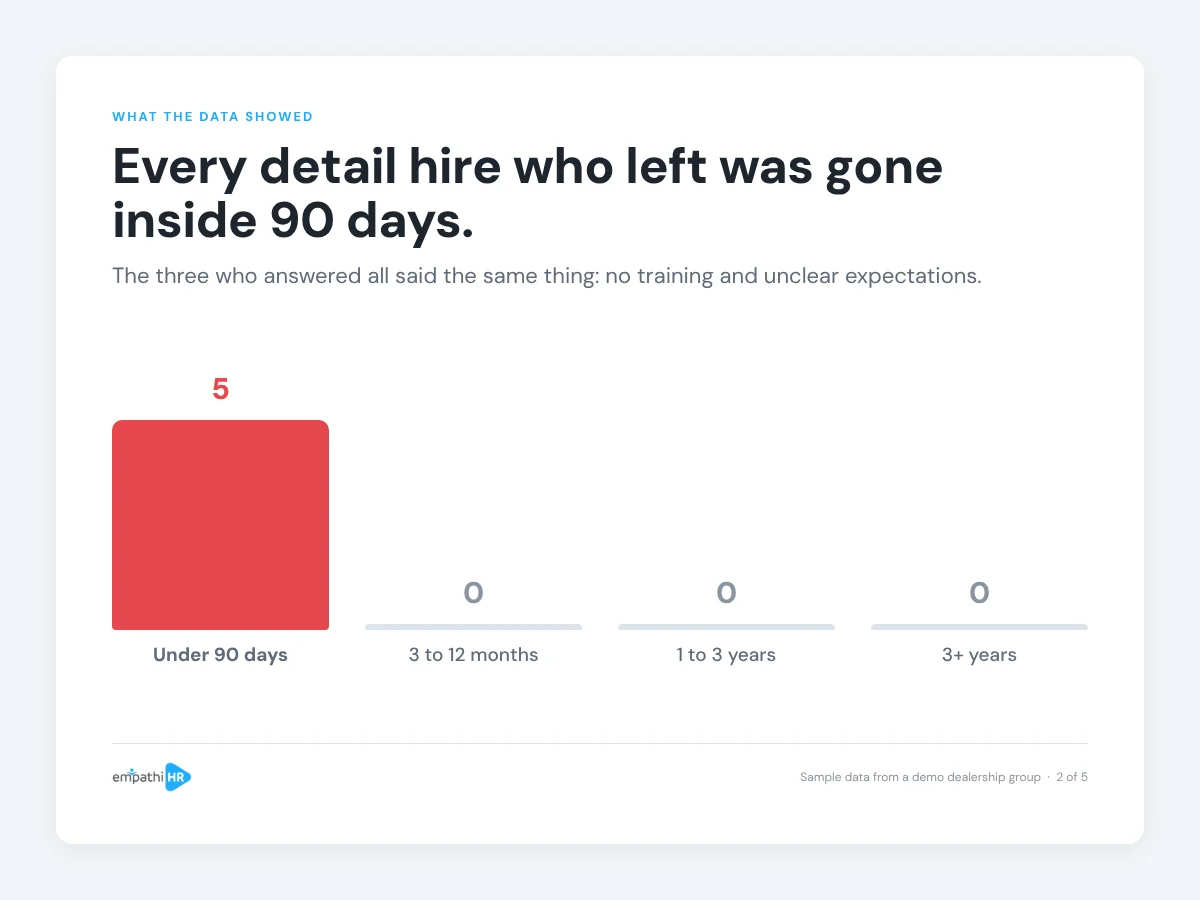
What the data showed
Five findings from a sample dealership group's exits.
Video, phone, or doing it yourself
All three can work. They differ in who the employee is talking to, how much of the job lands on your team, and what you are left holding afterward.
What HR heard vs. what the exit interview found
| What differs | empathiHR video | Outside phone interviews | Done in house |
|---|---|---|---|
| Who the employee is talking to | A neutral outside firm, recorded on their own, with nobody listening live | A neutral outside firm, with a stranger live on the line | The company they are leaving, often the manager they are leaving |
| Scheduling required | None. They answer whenever they have a few minutes | A call has to be set up, and both sides have to show up for it | A meeting, usually on or near the last day |
| Red flag follow up | A call to you within one business day, with an investigation ready to open | Varies by firm, and investigations are usually a separate engagement | Falls to whoever ran the meeting |
| Documented record | Video, transcript, and a written summary for every exit, declines included | Notes or a written summary, depending on the firm | Notes, if anyone took them |
| Work for your HR team | Send a name. Read a summary | Send a name, then chase the scheduling | Write the questions, hold the meeting, write it up, chase the no shows |
Exit interviews: common questions
What is a third party exit interview?
Do you work with employers of our size?
How long does the exit interview take for the employee?
Is the interview confidential?
What happens if the employee will not do a video interview?
Do you interview employees who were let go?
What happens if someone reports harassment or another serious concern?
Can interviews be done in Spanish?
How long do you keep the recordings?
Pricing
Exit interviews are available as an add on to an empathiHR program or as a standalone service. Investigations are already covered inside a program. Standalone clients are billed hourly for investigation time. Email hello@empathihr.com for pricing.
Add exit interviews to your empathiHR program.
Tell us how many people left last year. We will show you what you would have heard, and what it would have cost you to find out any other way.